

What Is the Restoring Soil Health Course All About?
The Restoring Soil Health course is a four-day intensive workshop offered each fall through Burnaby Community and Continuing Education at its Riverway location in Burnaby, British Columbia.
The course explores soil biology, compost and composting, microscopy, the production and application of compost extracts and teas—what I often call liquid bio-blends—and practical ways to observe what is happening beneath our feet.
The goal is to connect living soil theory with growing practices that students can use in their own gardens, farms and managed landscapes.
Understanding Soil as a Living Ecosystem
First and foremost, we begin with the foundation: how life is at the core of soil health. Life belowground supports plant growth, decomposition, nutrient cycling, soil structure, and overall resilience.
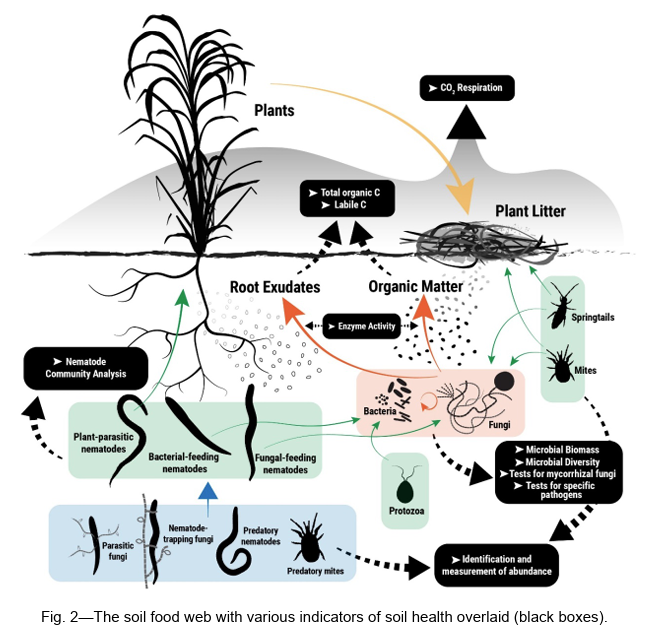
Brackin, Richard & Schmidt, Susanne & Walter, David & Bhuiyan, Shamsul & Buckley, Scott & Anderson, Jay. (2017). Soil biological health - what is it and how can we improve it?.
We explore the relationships between plants and microscopic life in soil and why supporting these relationships involves much more than just adding microorganisms to the soil or applying another bottled product.
*Biological inputs are useful tools, but lasting change also depends on creating the right environment for soil life to thrive: providing sufficient food, moisture and air, along with management practices that allow microorganisms to establish and function.*
Students also learn easy ways to observe and assess soil conditions using simple supplies such as a mason jar, chicken wire and patio-door screening. Yup, our slake test is very high-tech ;)
Building Biologically-Active Compost
On the very first day, after our lunch slump, the students and I build a thermophilic compost pile.
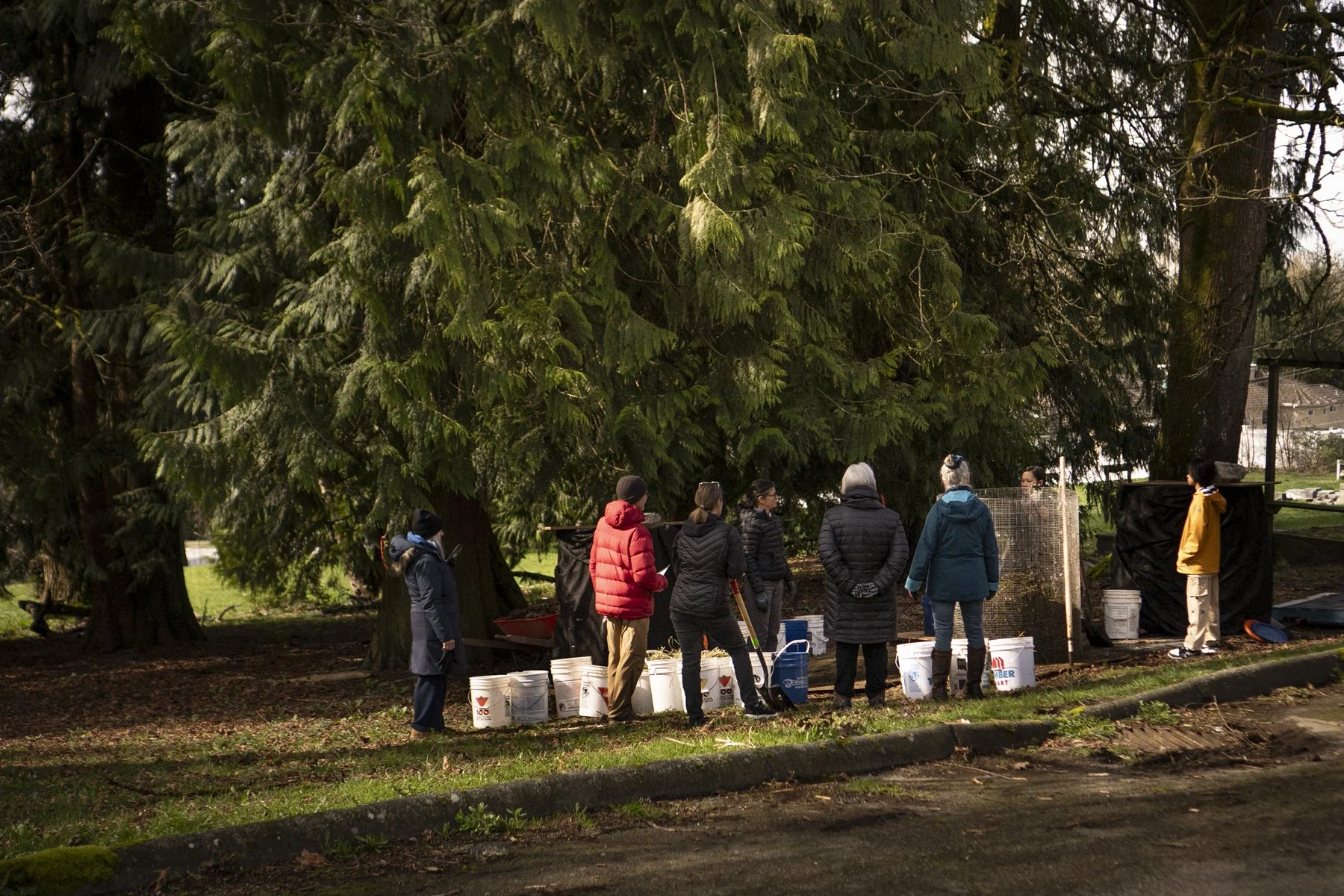
Photo by: Alieska Robles
Before the course starts, I collect and prepare a cubic yard's worth of ingredients. As a group, we discuss the role of each material, work through the compost recipe and assemble the pile.
Over the following weeks, we monitor its temperature and observe how the pile changes as it develops into a rich, dark brown, pricier-than-gold resource.
Students learn how ingredients, moisture, oxygen, temperature and pile management influence the composting process and the biological community that develops within it.
Exploring the Rhizosphere and Phyllosphere
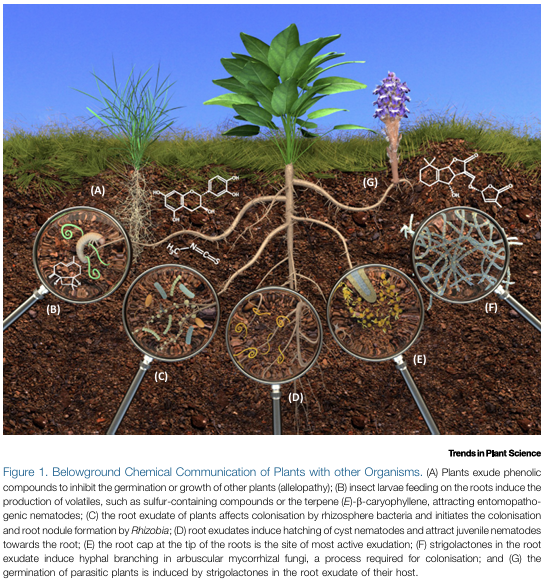
van Dam, N. M., & Bouwmeester, H. J. (2016). Belowground chemical communication of plants with other organisms [Figure 1]. In Metabolomics in the Rhizosphere: Tapping into Belowground Chemical Communication. Trends in Plant Science, 21(3), 256–265. https://doi.org/10.1016/j.tplants.2016.01.008
We nerd out over both the rhizosphere and the phyllosphere.
The rhizosphere is the biologically active area surrounding plant roots, where plants and soil organisms interact.
The phyllosphere covers the entire aboveground surface area of plants and the microorganisms that lives on those habitats. Think stems, flowers, fruits and seeds.
Together, we explore how these plant-associated habitats connect with nutrient acquisition, nutrient cycling, plant immune system regulation, decomposition, production of organic matter and soil aggregation.
There is always never enough time for these sessions.
Observing Soil and Compost Life Under a Microscope
This is usually when everybody gets really excited.
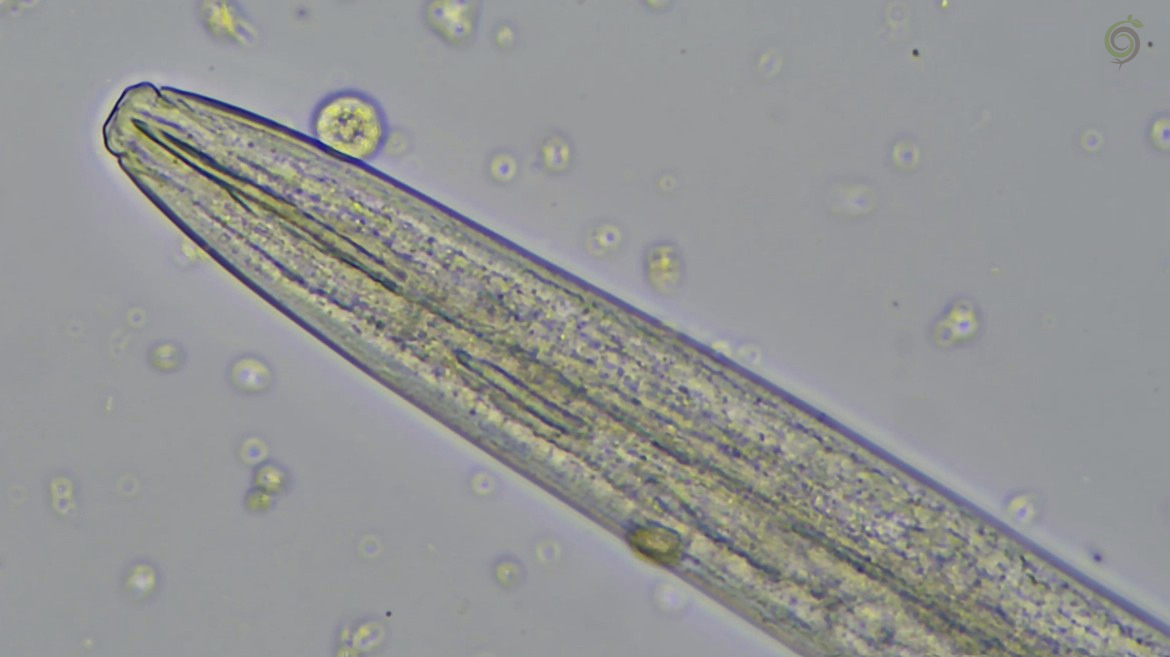
A fungal-feeding nematode.
Microscopy is one of the most popular parts of the course so I decided to offer one-day microscopy workshops in spring of 2025. It was definitely a hit!
Students bring their own compost and soil samples and use brightfield microscopes to observe nematodes, protozoa, and fungi. We discuss their morphological features and consider what their presence or absence (this happens more often than I thought) can tell us about their samples.
There is something really transformative and wondrous about seeing the unseen for the first time.
Making and Using Compost Extracts and Teas
Much like microscopy, this one is another major hit! I’m considering offering one-day workshops in the future on liquid bio-blends only, as I did for microscopy.
In this session, we explore how compost extracts and aerated compost teas can support plant and soil health. It also ties everything back to the rhizosphere and the phyllosphere and how liquid bio-blends can be used to restore those habitats.
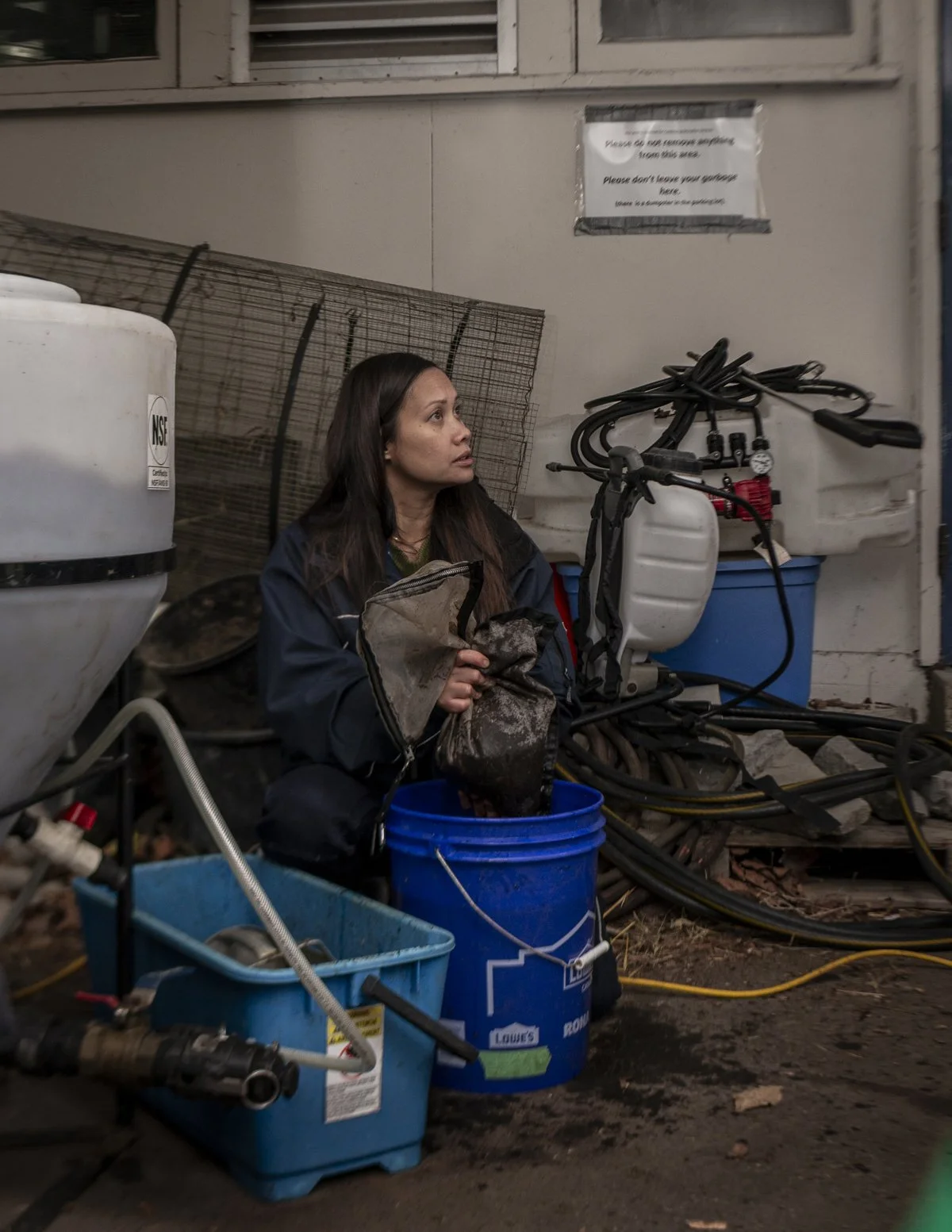
Making compost extracts in two different ways
manually, with a bucket
with an actual compost brewer
Students learn about:
the differences between compost extracts and teas
why the quality of your base ingredient—the compost— matters
the best way to transfer compost biology into water
how to apply liquid bio-blends, what you could add and when to use them
the soil and environmental conditions that organisms need after application
how these tools can fit within a broader approach to soil restoration
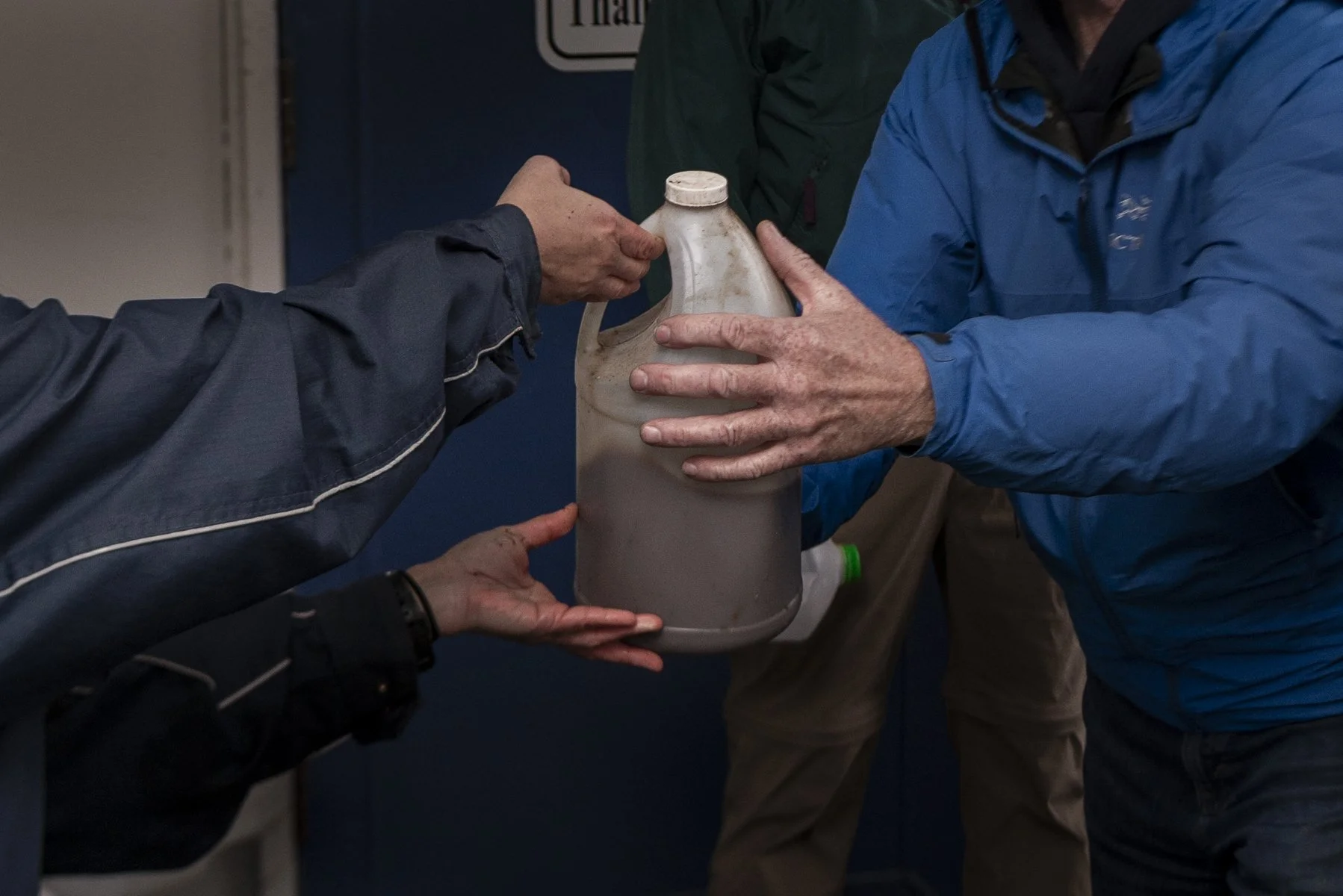
Home-made bugs in a jug.
Students also get to take home a jug or two of the liquid bio-blend we make in class so they can inoculate their compost, gardens or houseplants.
Learning from Real Growing Experiences
Whenever possible, I invite guest speakers to share how they work with plants, soil and living systems.
Past speakers have included Kevin Jinn of Carleton Landscaping, a fellow instructor at the school who specializes in designing native-plant-focused gardens. I also had Melissa Cook of Sea Breeze Florals, a dedicated and knowledgeable small-scale urban flower farmer. Melissa has shared her experience managing life in the soil of her flower farm, including what she has learned while growing dahlias and other cut flowers.
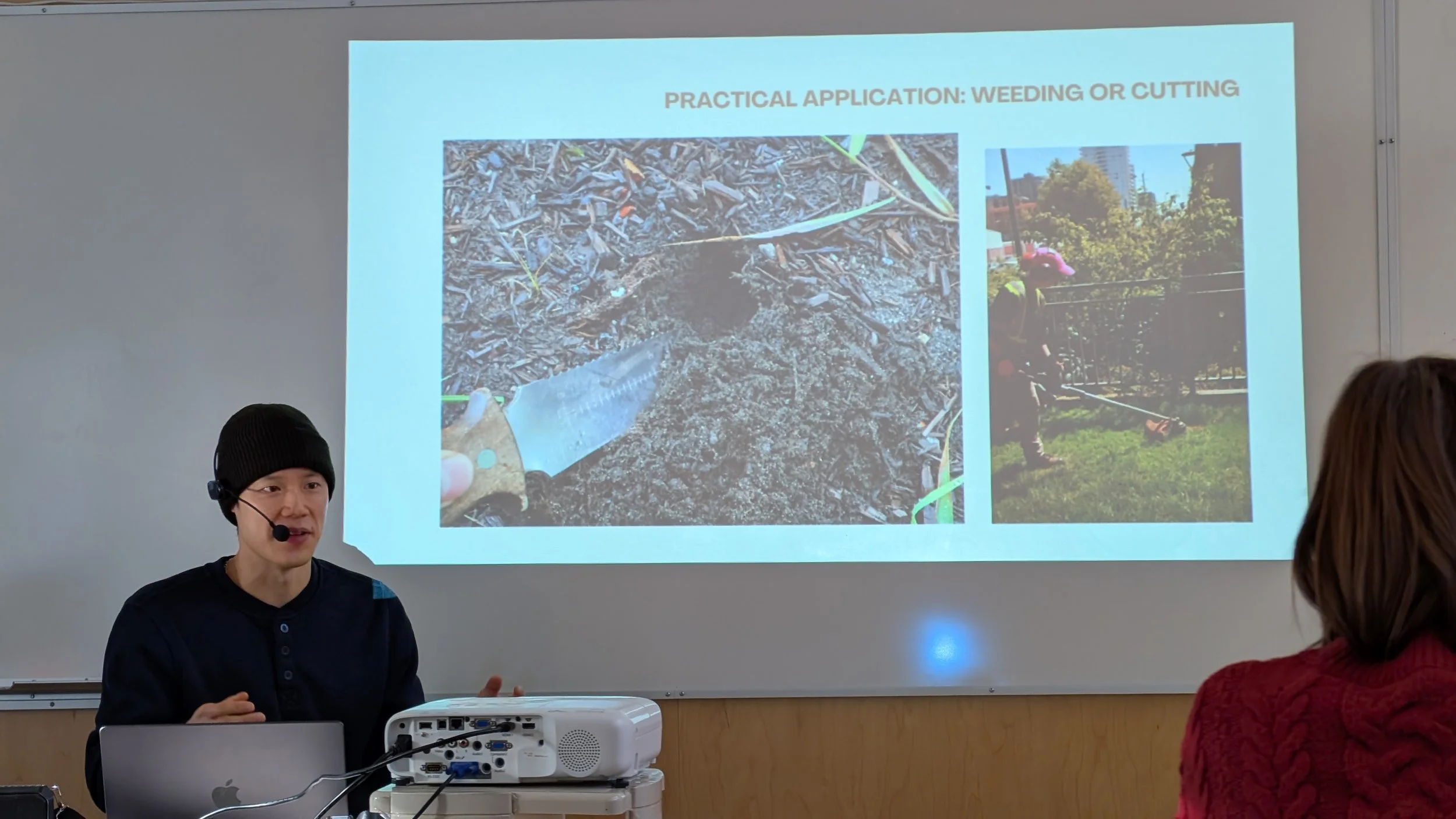
Kevin Jinn of Carleton Landscaping.
A fellow instructor at Riverway speaking about the benefits of integrating native plants into the garden.
Who is the Restoring Soil Health Course For?
This course is intended for:
home gardeners
small-scale farmers and flower growers
permaculture practitioners
parks staff
landscape designers and technicians
Really, anyone curious about restoring and sustaining life in their soil.
Learning Together
Teaching these workshops is a true joy for me.
Every session reminds me that I am still learning alongside my students as we dig into the mysteries of soil together.
We explore, observe, imagine and geek out as a group.
Time always flies, and students often wish we had more of it.
Melissa, one of my guest speakers, has even joined me more than once: first as a workshop participant in 2021, soon after as a client, and then again when she signed up for her second workshop in the fall of 2025.
She just can’t get enough of me…
But seriously, that curiousity and continued dedication to learning and growing are among the reasons I feel like I am still a student myself.
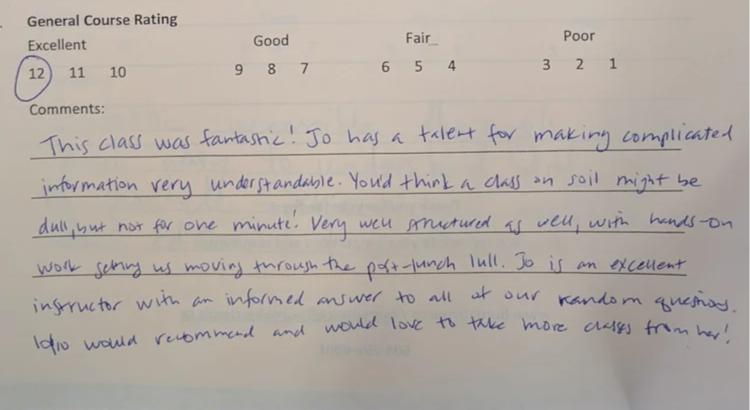
Student Feedback - Fall 2025
We get our hands dirty.
Our minds tickled.
Our bodies tired.
And our souls and soils nourished.
